What Is Body Checking? Why It's Harmful and How It Impacts Body Image


- Body checking is a compulsive behavior sometimes associated with eating disorders, but people who do not have an eating disorder can engage in body checking, too.
- Body checking involves compulsive and repetitive checking of your body size, shape, weight, etc.
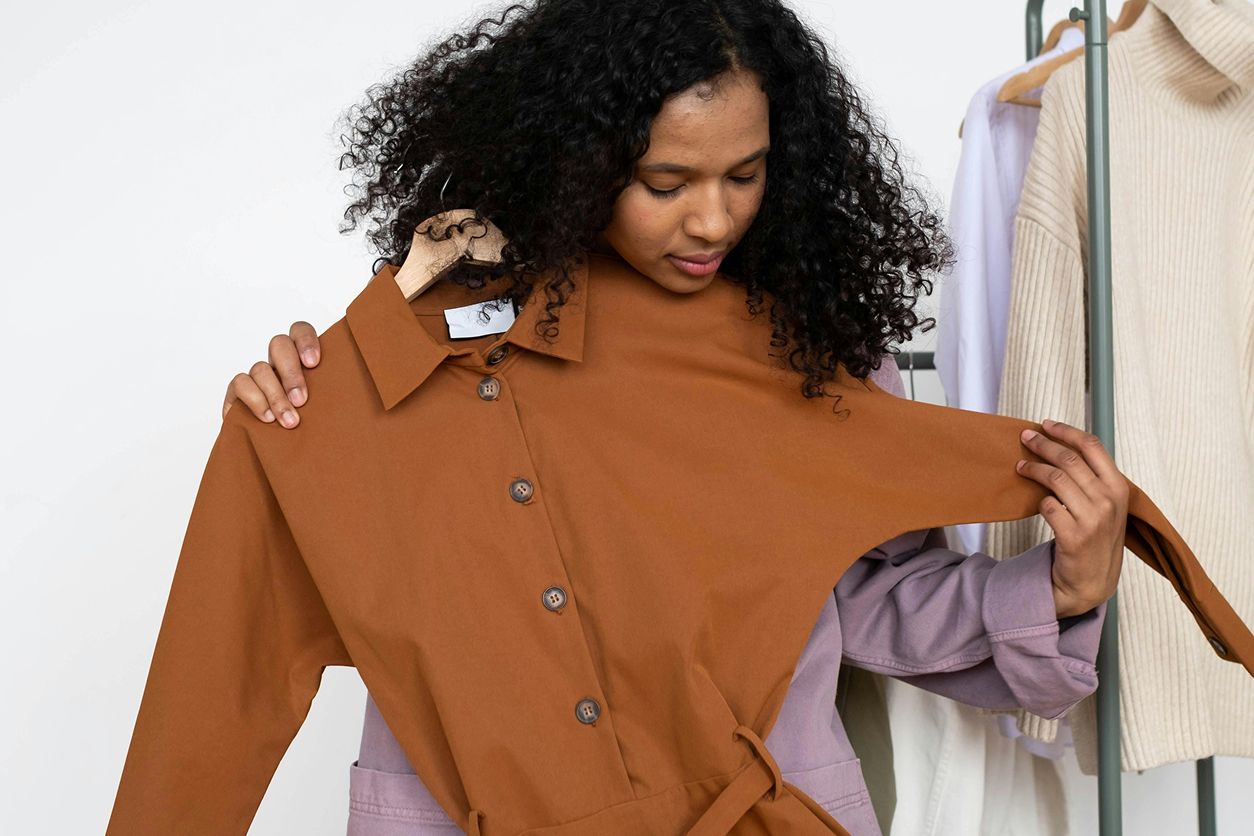
- It can show up as repeatedly looking in the mirror or trying on the same clothes to see if they fit, for example.
- Treatment is available and recovery is possible with the help of a knowledgeable care team.
I used to look at my body every which way in the mirror. Then I’d assess what I saw and go back to doing whatever I was doing, like working or reading a book. But then 15 minutes later, I’d be back in the bathroom, in front of the mirror, doing the same thing all over again.
Maybe this scenario sounds all-too familiar for you or a loved one. If so, body checking might be going on. Body checking is a behavior that is often associated with eating disorders, though not everyone who body checks has an eating disorder.
For me, an eating disorder was the main driver—in my 20s, a therapist diagnosed me with “eating disorder not otherwise specified (EDNOS),” now called otherwise specified feeding or eating disorder (OSFED)—but part of my body checking also had to do with chronic illness. At 21, I was diagnosed with endometriosis, a condition that can feature what’s called “endo belly,” severe and painful swelling and bloating that frequently altered my shape.
My body checking was a way for me to try to exert control over my body when I felt I had none. It was a coping mechanism, albeit not a healthy one, as it worsened my eating disorder.
In this article, we explore what body checking is, body checking examples, how to stop body checking, and more.
What is body checking?
Body checking is the compulsive monitoring of body shape, size, weight, and other factors. It shows up in a variety of different ways, such as frequently looking in the mirror, measuring body parts, pinching skin, or trying on clothes (even those already owned) to assess their fit.
We all look in the mirror, whether it’s a quick glance or part of getting ready for the day or an event. You might also try on clothes you already own, especially if you haven’t worn something in a while, to see how it fits. Sometimes you might even measure yourself to confirm your size before ordering a new pair of jeans.
These general behaviors aren’t body checking. But looking in the mirror, measuring yourself, skin pinching, or stepping on the scale can veer into body-checking territory if the behaviors become compulsive. This means you can’t stop body checking, even when it’s interfering with life and your enjoyment of it.
What does body checking look like?
Body checking can take many forms, and it might look different for you or a loved one than it does for other people. To help illustrate how it might show up, we’ve divided common body checking behaviors into categories and listed some examples.
Common forms of body checking
Visual checking
- Frequent mirror examination of specific body parts
- Turning sideways or twisting to assess shape
- Lifting shirt to see abdomen
- Comparing current shape to older photos
- Scrutinizing photos or taking repeated progress photos
Tactile (touch-based) checking
- Pinching body fat
- Measuring a thigh gap
- Wrapping fingers or hands around wrists, arms, or waist to gauge size
- Pressing on specific bones to assess their prominence
Measuring or weighing
- Weighing multiple times per day
- Measuring body parts frequently
- Checking how clothes fit throughout the day, such as waistband tugging
- Repeatedly trying on the same outfit to assess fit
Comparison checking
- Comparing body size to others in person
- Comparing yourself to others featured on social media, film, TV, etc.
- Mentally ranking your body parts against other people’s
Behavioral checking
- Sitting or bending to see if rolls appear
- Inspecting shadows or silhouettes
- Monitoring stomach size after eating
- Alternating between mirror avoidance and intense checking
Body checking isn’t always obvious or clear—sometimes it takes more subtle forms. We’ve included those here with some examples.
More subtle forms of body checking
Mental checking
- Mentally scanning specific body parts (without a mirror)
- Replaying how your body looked during a recent situation
- Imagining how today’s eating will change body shape later
Reassurance-based checking
- Casually prompting appearance-related comments
- Interpreting neutral comments as size-related feedback
- Comparing compliments over time to detect perceived body changes
Environmental manipulation
- Choosing seating, camera angles, or positioning to assess or control how your body appears
- Using specific lighting to evaluate contours
Performance checking
- Using how clothes stretch, restrict, or shift during movement as feedback about body size
- Assessing body size based on how much space is taken up, in a chair for example
- Standing in doorways or against walls to gauge body width
- Monitoring physical sensations (e.g., skin touching skin) as size indicators
Temporal checking
- Checking at specific times daily (e.g., immediately upon waking or before bed) to compare fluctuations
- Comparing weekday vs. weekend body perception patterns
Social media-driven checking
- Analyzing tagged photos before they appear in your feed
- Tracking likes/comments as indirect feedback about appearance
- Repeatedly reviewing posted images for perceived body flaws
Why do people body check?
“Body checking is compulsive behavior driven by insecurity or anxiety, where an individual focuses intensely on their body, usually hyper-focusing on specific parts like the legs, stomach, or arms,” says Jonathan Levine, a licensed clinical social worker who specializes in eating disorders at Equip.
“Body checking acts as a behavior to minimize that negative feeling by ‘checking’ to see if the perceived flaw is real,” Levine adds.
Researchers even refer to this type of behavior as a “safety mechanism.” It may temporarily bring about a sense of immediate relief from the initial anxiety or a sense of having control. But engaging in body checking also perpetuates the behavior, creating a vicious cycle. That sense of relief or of having control leads drives more body checking.
Going back to my personal example, my endometriosis frequently causes endo belly. This is a term to describe uncomfortable bloating. It can make my stomach feel generally normal one day, but then the next, I might feel like I am pregnant. In my body-checking era, I would check my stomach no matter which way I felt. When it was flat, I reassured myself it was flat. When it was distended, I reassured myself that I could still “suck” everything in.
Feeling like I had no control over the endometriosis, I turned to body checking to give myself a sense of control. But in doing so, I only reinforced my body-checking behaviors, which also included frequent weighing and trying on clothes to check if they were suddenly “tight.”
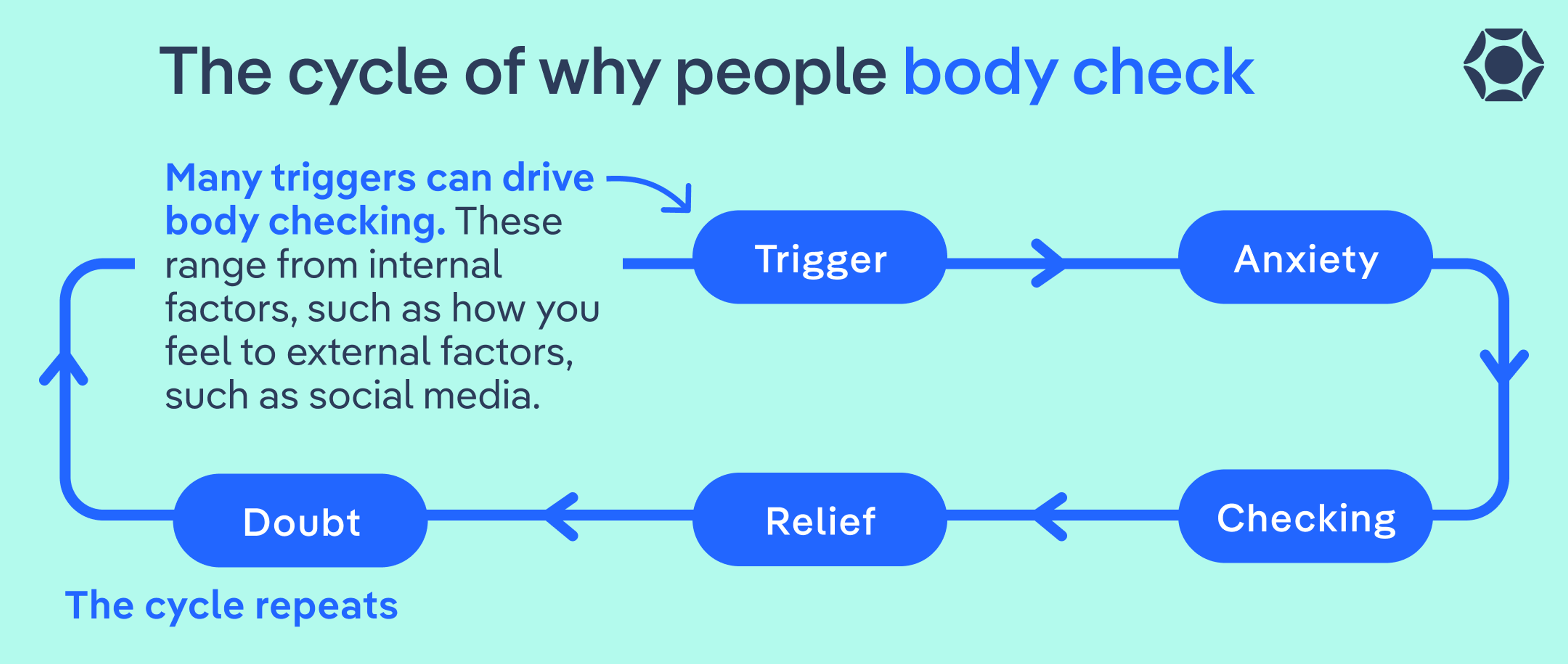
My example illustrates the cycle of experiencing a trigger, the trigger leading to anxiety, the anxiety prompting body checking, and the checking leading to relief. But then I’d experience doubt soon after a body-checking behavior and repeat the whole cycle.
Body checking triggers
Many triggers can drive body checking. These range from internal factors, such as how you feel (full for example), to external factors, such as social media. Reels and images often depict influencers and other content makers showcasing their bodies in ways that can trigger (or even be considered) body checking.
Sometimes people show before-and-after pictures to illustrate how a specific exercise routine or diet impacted their physical appearance. Other times they are even explicitly depicting body checking, such as measuring a “thigh gap” or showing that they can encircle their waist with their two hands. If you scroll through the comments section, you might see a mix of reactions—some people might point out that the person has gone to extremes, but others may praise the person for their appearance. This can ramp up your own body dissatisfaction or affect self-esteem if you feel you don’t measure up.
“Diet culture, or the expectation and belief that thin bodies are better, healthier, and more attractive than all other bodies, or that your body is the most interesting thing about you,” Levine says, are all triggers of body checking.
Additionally, internal triggers like a fear of weight gain or hyper-focusing on body image can drive body checking. Mental health also plays a role. Social anxiety and other forms of anxiety can trigger body checking, for example.
How is body checking connected to eating disorders?
Although eating disorders have many causes, body image distress and fear of weight gain are core symptoms of most, but not all, eating disorders. Body checking tends to become a natural behavior to cope with these feelings of distress and fear.
Eating disorders and body checking may even drive each other: one study found that body checking frequency on a given day was associated with restricting food on that same day in females with anorexia nervosa.
This was the case for me. If I engaged in body checking, how I felt after often dictated whether I restricted my meals or took exercise to an extreme, even when I was in intense pain.
When does body checking become a problem?
“Humans are curious creatures,” Levine says. “We all double-check, or even triple-check, many things in our day-to-day lives. Plus, our culture highly values aesthetics and thinness. Consequently, many people without eating disorders or disordered eating frequently check their bodies, how their clothing fits, or how they look in the mirror.”
These behaviors are relatively common and play into our body image, which doesn’t always feel positive. “Almost everyone has bad body image days regardless of whether they meet the criteria for an eating disorder,” Levine adds.
Someone might feel constipated or sluggish, or might be in the luteal phase of the menstrual cycle, when premenstrual syndrome (PMS) is common. In these instances, you might look in the mirror a bit more or go through multiple outfits in the morning to see what you feel good in.
These typical checking behaviors might veer into body checking if they occur frequently and you (or a loved one) find that you cannot stop doing them. “The shift from normalcy to one of harm resides in the compulsivity,” Levine says, “for example, leaving a social event to go to the bathroom to lift your shirt and check your stomach in the mirror.”
As this example illustrates, body checking causes you to become hyper-focused on your body, rather than focusing on the present and enjoying what you’re doing. The constant body-related distraction may leave you with what Levine describes as a “permeating sense of discomfort, unhappiness, or inadequacy.”
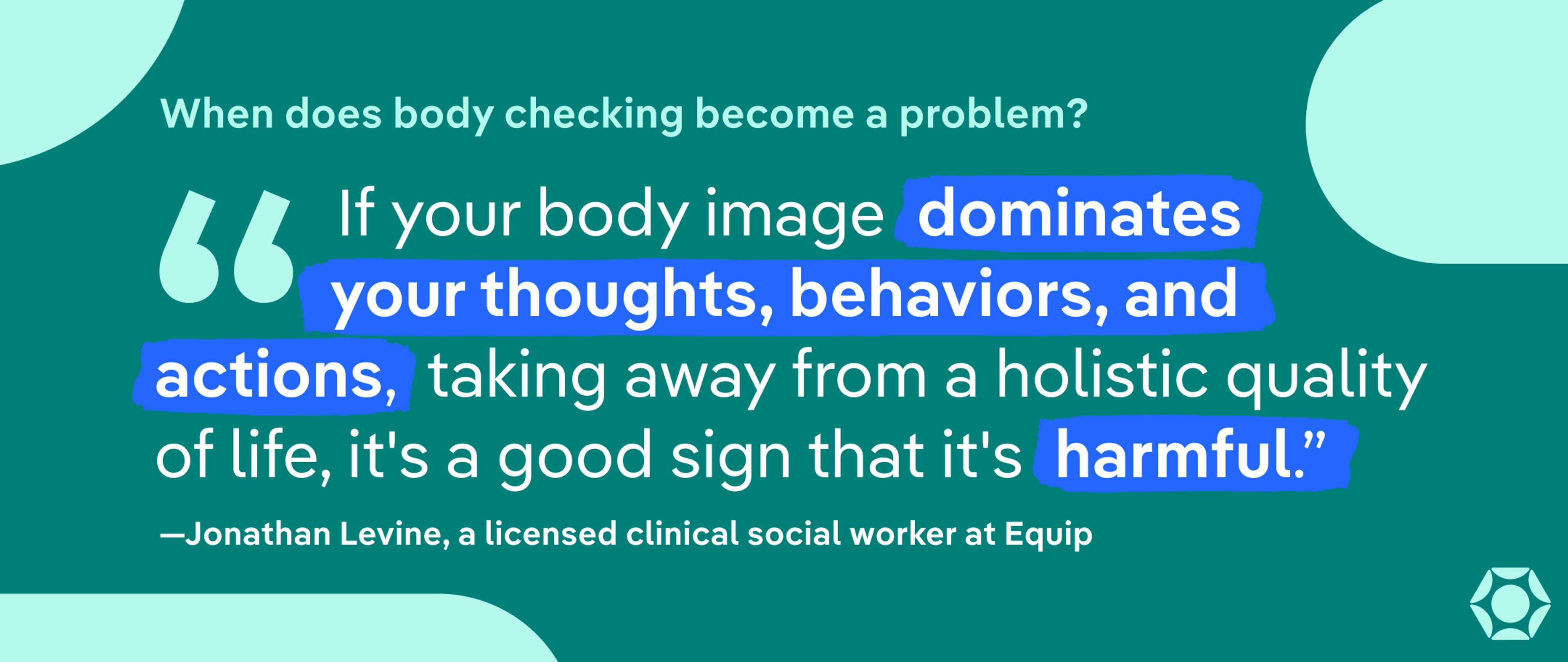
“If your body image dominates your thoughts, behaviors, and actions, taking away from a holistic quality of life, it's a good sign that it's harmful,” he says.
The table below illustrates the difference between the ways we typically check ourselves as part of everyday life and concerning body-checking behaviors.
Dimension | Neutral self-checking | Body checking |
Frequency | Occasional (e.g., before leaving the house) | Repetitive, ritualistic, or hard to resist |
Emotional tone | Neutral or practical | Anxiety-driven, self-critical, or shame-based |
Purpose | Grooming, hygiene, or dressing appropriately | Evaluating weight, shape, size, or perceived flaws |
Flexibility | Can skip it without distress | Skipping causes anxiety or discomfort |
Time spent | Brief (seconds to a minute) | Prolonged or repeated throughout the day |
Attention focus | Whole appearance | Fixated on specific body parts (e.g., stomach, thighs) |
After-effect | Move on with the day | Temporary relief followed by more worry or urges to re-check |
Impact on functioning | Does not interfere with work, relationships, or mood | Increases preoccupation, affects mood, or interferes with daily life |
Response to perceived changes | Mild adjustment (e.g., change outfit) | Behavioral compensation
|
How to stop the body-checking cycle
Body checking involves a cycle, as noted earlier in the article. But the good news is that you can interrupt the cycle. Levine offers a two-part approach that he uses for working with patients.
- Build awareness: “Many people don't realize they constantly touch their stomach or thighs as a form of body checking,” he says. “Building awareness of the behavior is a critical first step in being able to challenge it.”
- Decrease the behavior: “Once my patients understand how, why, and when they body check,” he says, “the goal becomes decreasing the behavior and eventually ceasing it entirely.”
For building awareness, you can ask yourself a few questions or go through them with a therapist.
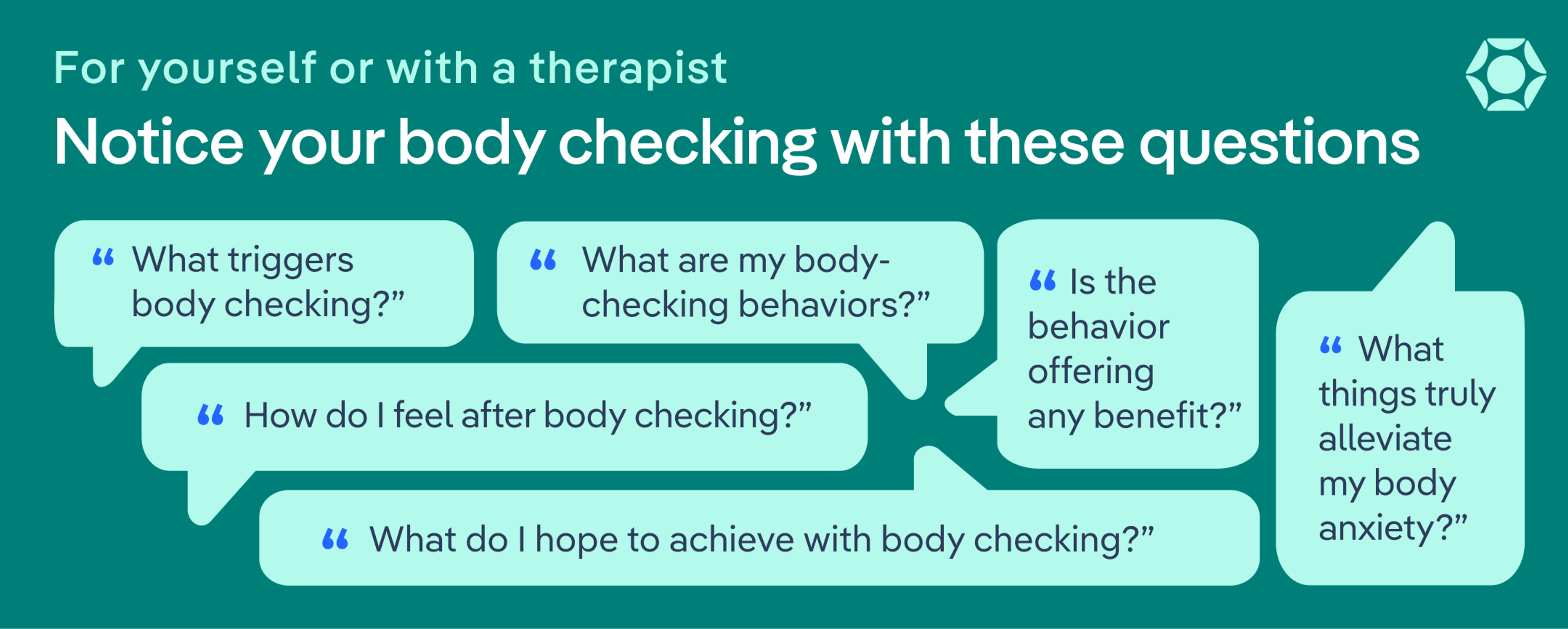
Ask yourself:
- What are my body-checking behaviors?
- What triggers body checking?
- What do I hope to achieve with body checking?
- How do I feel after body checking?
- Is the behavior offering any benefit?
- What things truly alleviate my body anxiety?
Once you gain awareness from your questions, you can find ways to decrease your body-checking behaviors.. “That can involve taking away access, such as putting blankets or sheets over mirrors in the house so you don’t catch a reflection and feel inclined to engage,” Levine says. This process doesn’t mean you would need to cover all your mirrors forever. It’s just a temporary way to help interrupt the cycle.
Another strategy for decreasing body checking might also involve asking for help from people in your support system. “If they notice you pinching your stomach, thighs, or cheek, they can redirect you to break the cycle,” Levine explains.
You might also choose to give away certain clothing items that you keep around to gauge specifically how you feel in them. These are just a few examples.
Ways to decrease body checking:
- Cover mirrors in your house (temporarily).
- Get rid of your bathroom scale or take out the batteries.
- Eliminate clothing from your closet that you use to “check” size.
- Give your body-checking tape measure to a trusted friend or family member.
- Decline to be weighed at doctor’s appointments, or close your eyes or look up when you’re on the scale and ask staff not to share your weight with you.
- Delete, or hide in a folder, any progress photos or other images you use as part of body checking.
- Ask friends and family to note if they see you pinching or checking size in some other way.
- When the body-checking urge occurs, revisit the list of questions above and see if you can arrive at a different coping method for the trigger.
Again, these measures are meant to be temporary to help you break the trigger-body-checking cycle. Once you disrupt the cycle, you will likely engage in body checking much less.
However, if you find that you are struggling to stop or just want some professional guidance, never hesitate to reach out to a knowledgeable mental health professional. They can tailor strategies that work for you.
The bottom line
I’m happy to report that I no longer engage in body checking and am recovered from OSFED. I share this to illustrate that recovery is possible, and you can free yourself from the body-checking cycle.
Of course, I still look in the mirror. But now it’s usually to make sure I don’t have kale in my teeth or that my bangs aren’t giving too much of a bed-head vibe, rather than to assess my stomach size. This change has been liberating.
If you or a loved one is looking for recovery options or help with body checking, know that care is available. Talk with a trusted doctor or schedule a call with Equip to talk through your concerns and explore treatment options.
FAQ
What does body checking look like?
Body checking can take many forms, but commonly it looks like frequent checking in the mirror, compulsively pinching body parts or checking their size in other ways, constantly stepping on the scale, repeatedly trying on the same clothes to see how they fit, taking progress photos and overanalyzing them, and more.
How can body checking be stopped?
Body checking can be stopped. The process involves interrupting the cycle. The first step is gaining awareness of your specific body checking habits, then you can work to decrease them. Sometimes this involves interrupting triggers. An example might be donating the clothing item you try on frequently to assess fit.
Is body checking always a sign of an eating disorder?
No, body checking is not always a sign of an eating disorder. It might show up as part of an anxiety disorder for example. However, body checking is a common behavior for certain types of eating disorders, such as anorexia nervosa (though not everyone with an eating disorder body checks).
Hofschröer, Vanessa, et al. “Short-Term Functions and Long-Term Consequences of Body Checking as a Transdiagnostic Phenomenon across Eating Disorders, Body Dysmorphic Disorder, and Illness Anxiety Disorder: A Systematic Review.” Journal of Eating Disorders, vol. 13, Dec. 2025, p. 281.
Krohmer, Kerstin, et al. “Hormones Matter? Association of the Menstrual Cycle With Selective Attention for Liked and Disliked Body Parts.” Frontiers in Psychology, vol. 10, May 2019, p. 851.
Lavender, Jason M., et al. “A Naturalistic Examination of Body Checking and Dietary Restriction in Women with Anorexia Nervosa.” Behaviour Research and Therapy, vol. 51, no. 8, May 2013, p. 507.
Munro, Emily, et al. “Diet Culture on TikTok: A Descriptive Content Analysis.” Public Health Nutrition, vol. 27, no. 1, Sept. 2024, p. e169..
Nikodijevic, Alexandra, et al. “Body Checking and Body Avoidance in Eating Disorders: Systematic Review and Meta-Analysis.” European Eating Disorders Review: The Journal of the Eating Disorders Association, vol. 26, no. 3, May 2018, pp. 159–85.
Opladen, Vanessa, et al. “Revisiting the Postulates of Etiological Models of Eating Disorders: Questioning Body Checking as a Longer-Term Maintaining Factor.” Frontiers in Psychiatry, vol. 12, Jan. 2022, p. 795189.
Velho, Renata Voltolini, et al. “Endo Belly: What Is It and Why Does It Happen?-A Narrative Review.” Journal of Clinical Medicine, vol. 12, no. 22, Nov. 2023, p. 7176.